
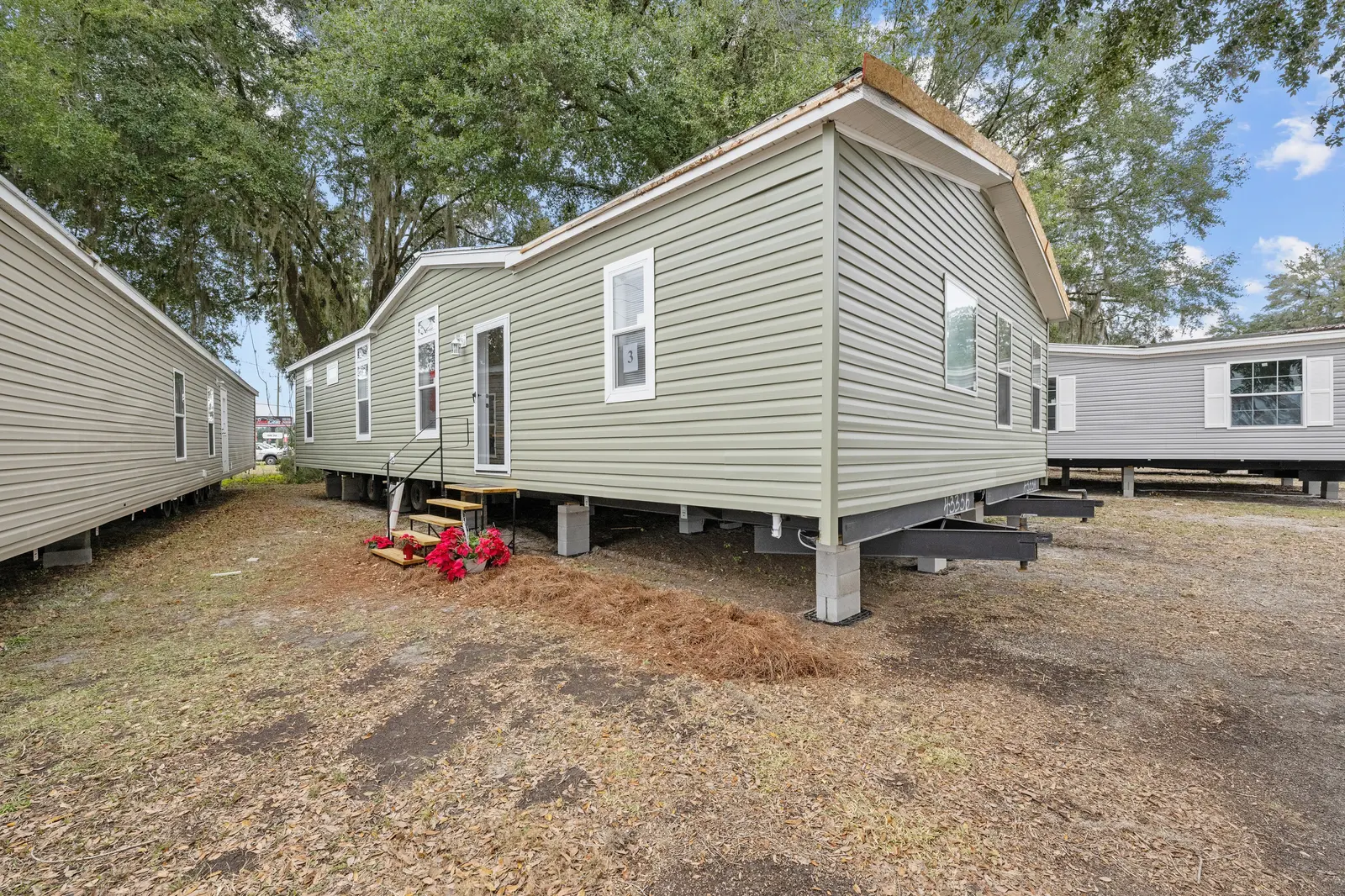
01No land? Start right here
No land?
No problem.
Plenty of folks who come see us don't own land yet. Here's how buying a home really works, start to finish — and we start with the land, because it decides just about everything else.
02Three ways to get on some land
Pick your land before your floor plan.
A lot of dealers skip right past this talk because it's the one about money. But it's the talk that sets your monthly payment, your interest rate, and whether your home's worth more or less fifteen years from now.
Lease a pad
Cheapest to enterYou own the home, somebody else owns the dirt, and you pay lot rent every month. It's the quickest, lightest way in — just the home to buy. The catch: the home usually gets titled like personal property, so it loses value the way a pickup does, and whoever owns the park decides the rent.
Ask the park office what the lot rent's done these last ten years and what it pays for. If they won't say, well, there's your answer.
Buy the lot
Builds equityThe ground is yours. Put the home on a permanent foundation and it can be titled as real property, so it gains value right alongside the stick-built house next door — and conventional, FHA, VA and USDA loans open up. It takes the most money up front, and it's the one road that dependably pays you back.
Before you buy a piece of land, check the road in, the utilities, the setbacks and the flood zone — ask us and we'll help you think it through. A cheap lot with no water line ain't cheap.
Land-home package
One closingLand, site work and home all rolled into one loan with one closing. A little more paperwork at the start, a lot fewer surprises at the end — and for somebody buying both at once, it's usually the cheapest money going.
Get the site-work figure on paper before the loan amount gets set. That's the number that wiggles, and it's the one most folks never see written down.
Don't have land yet? We put together land & home packages right here in Gainesville, and we work with experienced lenders who know these loans inside and out. Tell us about your land, or the land you've got your eye on, and we'll talk through what it takes to set a home on it.
03One step at a time
Seven steps, in the right order.
Go in this order and buying a home is downright boring — the good kind. Go out of order, floor plan first and land last, and that's where the horror stories come from.
- 01
Figure out the land first
Rent a lot, buy land, or go with a land & home package. That one call can swing your monthly payment by a few hundred dollars and decides which loans you can even get. Everything else hangs on it, so start here.
- 02
Budget the whole thing, not just the home
The home's price ain't the whole price. Tack on site work, foundation, delivery and setup, skirting, steps, hooking up the utilities, permits — plus lot rent or the land. Ask whoever you're buying from for that total on paper, and ask early. Ask us too.
- 03
Get pre-approved, not just pre-qualified
Pre-qualified means a lender's being friendly. Pre-approved means somebody actually looked at your numbers. It won't cost you a dime, and it tells you which of those land roads you can really travel instead of just wishing on.
- 04
Make sure the home fits the spot
A 32-foot-wide doublewide won't fit on every lot or make it down every dirt road. Tell us where it's headed and we'll help you sort out which singlewides, doublewides and triplewides will actually go there — before you fall for one that won't.
- 05
Walk the site and get the setup cost on paper
The road in, utilities, setbacks, the soil, permits, and the pad or foundation. This is where folks get caught off guard, so you want it written down, not just talked about over the tailgate.
- 06
Order it, build it, haul it, set it
Once it's ordered, the home is framed under a roof on a jig and inspected right there in the plant. Then it rolls to your place on its own chassis and gets set. Ask us how the deposit and the build schedule work for the home you pick.
- 07
Finish up, hook up, hand over the keys
Finish the seam where the halves meet, hook up the utilities, skirting, tie-downs, then a walk through together. On your own land, the foundation gets certified here and the loan funds — so you're not paying a mortgage on a pile of lumber.
04Costs past the sticker price
The price on the listing ain't the whole price.
These are the pieces that turn the price of a home into the cost of moving in. Ask about every one of them, on paper, before you order — better than finding them out one at a time.
Pad or foundation
Piers and anchors on a rented lot, or an engineered foundation on your own land. You need the second one to title it as real property.
Site work
Clearing, grading, a driveway, a culvert, septic or sewer, a well or water line, running power. Out in the country, this is the number that moves the most.
Transport and set
Hauling each half out and getting it into place. How far it goes and how easy it is to get to decide the cost.
Skirting, steps and decks
Most inspectors want them in place before they'll sign off, and they're hardly ever in the price on a listing.
Utility connections
Water, sewer, power and gas, from where it comes in to the home. A short run's cheap. A long one isn't.
Permits and inspections
The county permit, zoning and setback approval, electrical and plumbing inspections, and a foundation certification if you need one.
Lot rent or the parcel
On a rented lot, rent plus a deposit. On land you buy, the price, the closing costs and the property tax.
Insurance and taxes
Insurance on a manufactured home is its own kind of policy. Titled as personal property, you may pay a tag-style tax instead of property tax.
05Personal property or real property
Same home. Two whole different animals.
A manufactured home comes out of the plant with a certificate of origin, same as a truck off the line. On a rented lot it usually stays that way — titled as personal property, paid for with a chattel loan, taxed and insured to match, and losing value on paper no matter how good it's built.
Set that very same home on your own land, on a permanent foundation, and fold the title into the real estate, and the bank, the appraiser and the county all see a house. Here in Florida, the title gets retired with the DHSMV and the county tax collector issues an RP decal. Longer loan, lower rate, and it rides the housing market up instead of down.
Neither one's wrong. Renting a lot gets folks into a home years sooner than saving up for land would. Just make sure it's a choice you made with your eyes open, not something that snuck up on you at closing.
06Common questions
What folks ask us out on the lot.
Sure can — most folks don't have land when they first come see us. You rent a lot in a park and own the home that sits on it, and that's the quickest, cheapest way in. The tradeoff is the home usually gets titled as personal property, so it loses value, and the park owner sets the rent. If you'd rather build equity, price out buying land or a land & home package before you decide.
If it's on your own land, on a permanent foundation, with a real-property title — yes. Conventional, FHA, VA and USDA lenders all make loans on manufactured homes, and Fannie Mae's MH Advantage and Freddie Mac's CHOICEHome programs price the homes that qualify at or close to stick-built rates. On a rented lot you're looking at a chattel loan — a real loan, backed by the home instead of the land, with a higher rate and a shorter term. Both get you home; one costs less. Here's how each kind of loan works.
Put it on your own land, on a permanent foundation, titled as real property, and it acts like a house. Put it on a rented lot, titled as personal property, and it mostly acts like a truck. That comes down to the land and the title, not how it's built — it's the very same home either way — and it's the most important thing to get straight before you sign a thing.
It's a HUD-code home built with the features that let it appraise next to stick-built houses: a permanent foundation, a porch, drywall all the way through and a steeper roof. It's the kind of home that closes the gap between manufactured and stick-built lending. Ask us which homes we can get built that way.
Building and setting the home is usually the quick part — ask us what the plant is running for the home you like. What really eats up the calendar is the land. A park application might clear in a week; a piece of land that needs a septic permit and power run out to it can take a whole season. Get that going first and the rest falls in line.
You can — it came from the plant on a chassis. But it costs a good bit, takes permits and a moving outfit, and older homes don't always ride well. Put it where you mean for it to stay, and think of moving it as a last resort, not a selling point.
What the lot rent is and what it covers. What it was each of the last ten years. Who owns the park, and whether it's been sold lately. What the rules say about dogs, company staying over, renting it out and selling your home where it sits. What happens to your lease when you sell, and whether there's a fee to leave or transfer. And get every answer written down.
Come on by and ask us anything.
We've got 97 plans to look at out of Gainesville, from 499square feet on up. Bring a parcel number, a piece of land, or nothing but questions — we've been doing this since 1961, and we'll start right where you are.